What are UV radiation and the UV Index?
Reducing exposure to the sun is an effective way to decrease the harmful effects of UV radiation. The Finnish Meteorological Institute’s UV Index service provides information on when and where it is necessary to protect yourself from the sun.
The UV Index Describes the Intensity of UV Radiation
In Finland, the UV Index (UVI) is used to assess the need for sun protection. It expresses the amount of the sun’s harmful UV radiation as a single number. The UV Index can be used to describe both forecasted and measured levels of UV radiation.
The UV Index recommended by the United Nations is used worldwide in a consistent way. The variation in the index is mainly influenced by location on the Earth as well as the time of year and time of day. In addition, the UV Index is affected by cloud cover, altitude above sea level, and the amount of ozone in the upper atmosphere.
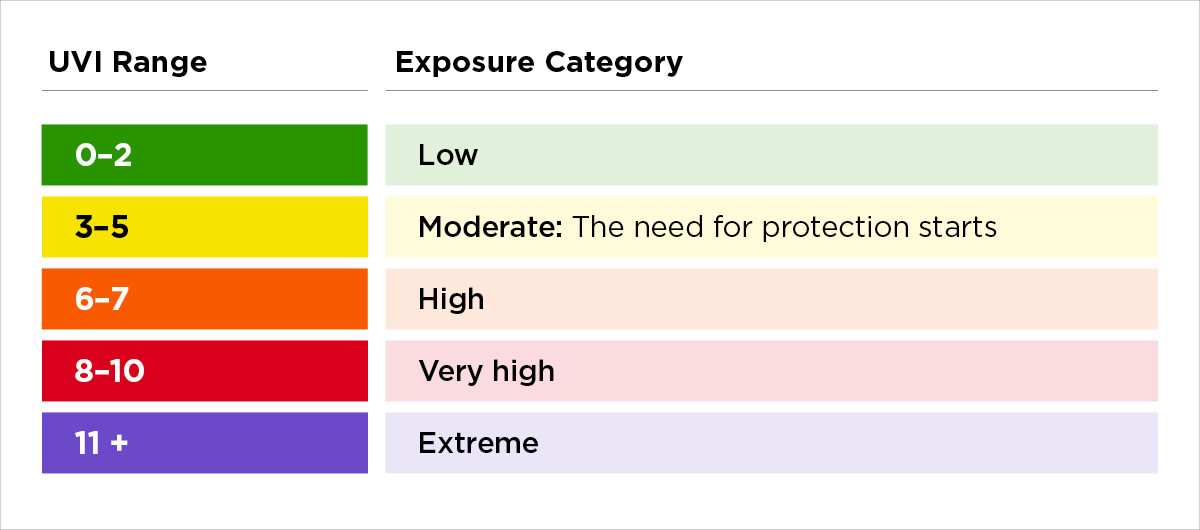
Sun protection is recommended when the UV Index reaches 3 or higher. In southern Finland, a UV Index of 3 occurs from May to August, and on a clear midsummer day it can last for as long as seven hours, from 10 a.m. to 5 p.m. A UV Index of 6 or higher indicates strong radiation, while values of 8 and above represent very strong radiation.
In southern Finland, the UV Index on a cloudless midsummer day typically ranges between 5 and 7 around midday. In Mediterranean countries, UV radiation is stronger during the day, but the period requiring protection is roughly similar. Near the equator, midday UV radiation is extremely strong throughout most of the year. A UV Index above 11 indicates extreme radiation levels, which occur in mountainous regions or near the equator. The highest recorded UV Index value, 20, has been measured in the Andes in Chile.
Typical UV index on a sunny day
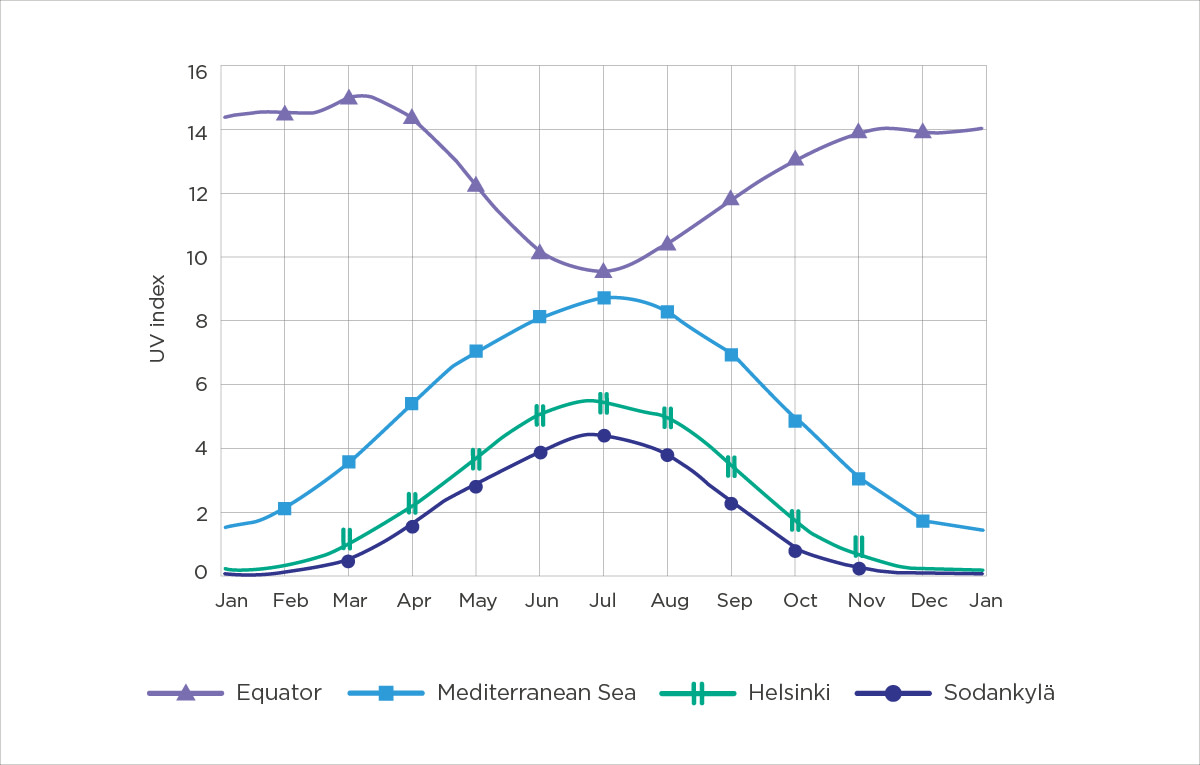
Typical maximum UV Index values in different parts of the world (Location and highest UV Index)
Sodankylä in summer: 4–5
Helsinki in summer: 5–6
Malmö, Sweden, in summer: 6–7
Las Palmas in December: 3–4
Las Palmas in March: 6–7
Mainland Greece in summer: 9–10
Davos (mountain region) in June–July: 10–12
Sri Lanka, Central Africa, Northern Australia: over 12
Solar UV Radiation: Electromagnetic Radiation from the Sun
In addition to visible light, solar radiation also includes invisible infrared (heat) radiation and ultraviolet (UV) radiation. Ultraviolet radiation is a form of electromagnetic radiation located between visible light and X-rays. UV radiation is divided into three types: UV-A, UV-B, and UV-C. UV-C radiation from the sun is completely absorbed by the ozone layer in the atmosphere, as is part of UV-B radiation.
The UV Index represents the amount of UV radiation that is significant in causing skin reddening (sunburn).
Excessive UV radiation can burn the skin and increase the risk of skin cancer
UV radiation affects melanocytes, the cells responsible for producing skin pigment. As the skin is exposed to UV radiation, it becomes tanned. UV-A radiation darkens existing pigment, while UV-B radiation stimulates the production of new surface skin cells, leading to thickening of the skin and the formation of new pigment.
A tan is the skin’s natural defense mechanism, aimed at reducing the penetration of harmful ultraviolet radiation into deeper layers of the skin. However, excessive exposure can cause sunburn. Too much UV radiation also accelerates skin aging, causing the skin to become dry, rough, and unevenly pigmented.
The skin does not forget UV exposure—its effects accumulate over a lifetime. For this reason, it is important to avoid excessive UV radiation or protect yourself from it even when there is no immediate risk of sunburn. This is especially important for children and young people. Increased exposure may only become apparent years later as health problems.
Exposure to UV radiation increases the risk of skin cancer. More than 80% of melanoma cases could be prevented by protecting the skin from sunburn. Individual behavior plays a major role in public health: the popularity of tanning, increased time spent outdoors in light summer clothing, and holidays in sunny southern destinations have increased UV exposure far more than changes in the atmosphere.
Skin Type Indicates Susceptibility to Sunburn and Tanning
Different skin types tolerate sun exposure differently and can be broadly classified as follows:
Skin Type – Burning and Tanning Response
I - Always burns easily, never tans
II - Burns easily, tans minimally
III - Sometimes burns, tans uniformly
IV - Rarely burns, tans easily
About one third of Finns belong to skin types I–II. Most people have skin type III, while about one in ten have skin type IV. Darker skin reacts more slowly to sunlight, whereas lighter skin is more sensitive. Red-haired and very fair-skinned individuals generally tolerate sun exposure poorly.
Even at its best, a tan provides protection roughly equivalent to a sun protection factor (SPF) of 4. UV radiation can penetrate even tanned skin and damage tissues. The skin does not become more resistant through repeated sunburn; in fact, the opposite is true. Protecting especially children’s skin from repeated sunburn significantly reduces the risk of skin cancer later in life.
UV Radiation Damages the Eyes
In addition to the skin, the eyes are also sensitive to UV radiation. Excessive short-term exposure can cause an acute inflammatory condition known as snow blindness. It is painful but fortunately temporary.
Long-term exposure to UV radiation can lead to the gradual development of clouding in the eye’s lens, meaning that cataracts may begin to develop at an earlier age. Protecting children’s eyes is particularly important, as the lens of a child’s eye allows more UV radiation to pass through than that of an adult. Some UV radiation can even reach the retina, where it may gradually damage retinal cells.
The best way to protect your eyes from UV radiation is to wear a wide-brimmed hat and sunglasses. High-quality sunglasses not only filter UV radiation effectively but also block radiation entering the eyes from the sides.
UV Radiation from Tanning Beds Can Be Stronger Than Sunlight
Tanning beds produce very strong UV-A radiation compared to natural sunlight, which causes the skin to tan quickly. More information on the use of tanning beds is available on the website of the Radiation and Nuclear Safety Authority (STUK).