Study explains discrepancy in aerosol deposition measurements

In atmospheric models, “deposition velocity” is usually defined as a proportionality coefficient linking deposition flux to atmospheric concentration. In many field studies, however, deposition velocity is calculated simply as the ratio of the measured vertical flux to concentration – a quantity the researchers call an apparent deposition velocity. The two definitions are equivalent only if several assumptions hold, including that no sources, sinks or phase changes occur between the measurement height and the surface, and the assumption of sufficiently small observation uncertainty.
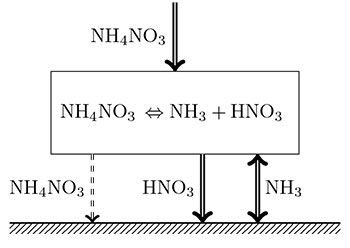
In an article published in Geoscientific Model Development, the researchers show that for ambient aerosols containing semi-volatile compounds, vertical particle fluxes can be controlled by gas–particle partitioning near the ground rather than by particle deposition itself. Ammonium nitrate, often a major component of PM2.5, is one of such compounds. When even a small amount of ammonium nitrate decomposes close to the surface into rapidly depositing gases, the gases drive the downward particle flux above the surface, breaking the assumed proportionality between particle flux and concentration.
Using the FMI-developed chemistry–transport model SILAM, the study demonstrates that the simulations can reproduce the strong particle fluxes observed in field measurements, even though the actual particle deposition velocities in the model are much smaller and consistent with wind-tunnel experiments.
Clarifying the difference between deposition velocity as a model parameter and apparent deposition velocity from field observations helps to explain long-standing discrepancies between experiments. The results can reduce uncertainties in simulations of aerosol concentrations and depositions in air pollution applications – and in assessments of radiation dose rates and fallout following accidental releases of radioactive substances.
Further information:
Senior Researcher Rostislav Kouznetsov, Finnish Meteorological Institute, tel. +358 29 539 4630.
The e-mail address is in the format forename.surname@fmi.fi.
Scientific article is openly available in Geoscientific Model Development.
Reference: Kouznetsov, R., Sofiev, M., Uppstu, A., and Hänninen, R.: Deposition velocity concept does not apply to fluxes of ambient aerosol, Geosci. Model Dev., 19, 1833–1847, https://doi.org/10.5194/gmd-19-1833-2026, 2026.