FMI Early Career Scientist Award to Three Researchers

The FMI Early Career Scientist award is based on an excellent peer-reviewed research publication published in the previous year, in which the recipient is the first author. The award is intended for undergraduate and graduate students, and post-doctoral researchers who have graduated no more than five years before the end of the previous year. The prize is 1,000 euros.
The award jury included Jari Liski (FMI), Professor, Chancellor Kaarle Hämeri (University of Helsinki), Professor Leena Järvi (University of Helsinki) and Professor Miina Rautiainen (Aalto University).
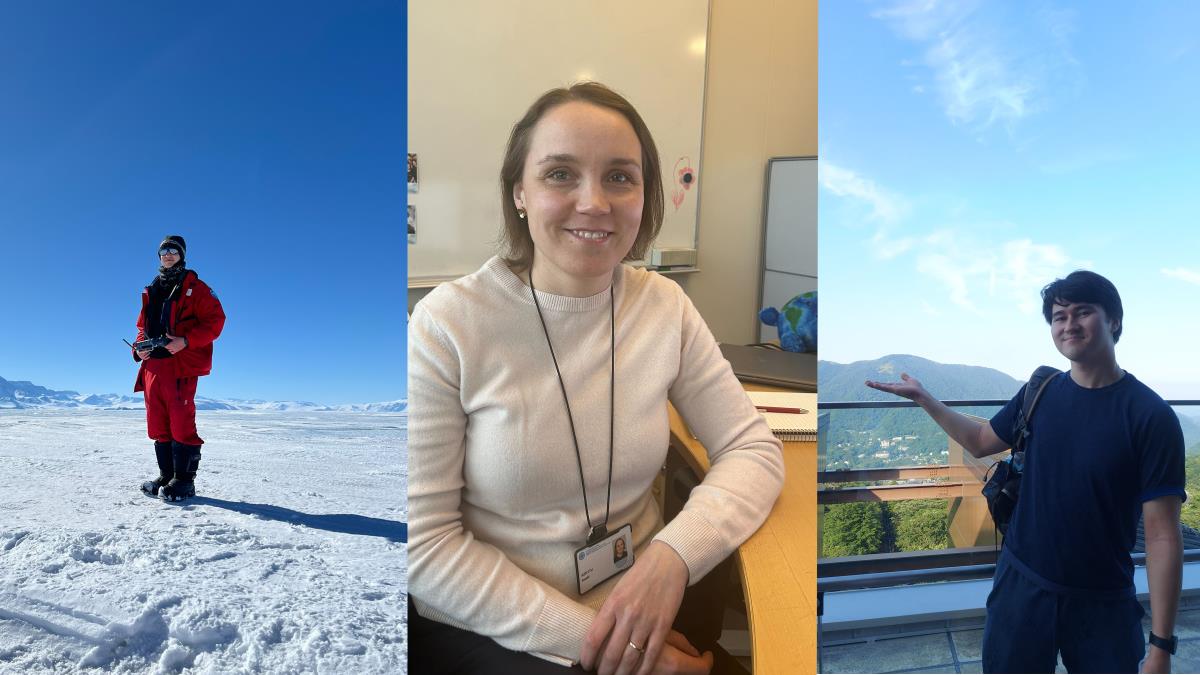
Daan van den Broek gets to see some of the most beautiful places on Earth through his work
Daan’s work focuses on changes in weather systems in the polar regions in a warming climate, particularly on extreme weather events and their increasing persistence. His research Svalbard's record-breaking arctic summer 2024: Anomalies beyond climatological warming trends. focuses on an extreme temperature event caused by such persistent weather. His interest in weather and the polar regions began in childhood and later led him to study atmospheric sciences in Wageningen and Helsinki, as well as to take courses in Arctic meteorology, climatology, and oceanography in Svalbard.
"Already when I was 4 years old, I said I wanted to become a ‘weatherman’. I was especially fascinated by winter weather and the polar regions… When I realized that analyzing weather and climate data could be a profession, I started deliberately working towards that goal. ... Almost every single day I'm excited to start working. Doing fieldwork and taking measurements in extreme and remote locations – and, in my opinion, some of the most beautiful places on Earth – is another privilege of my work", Daan tells.
One of the best aspects of research work is the opportunity to work daily on topics that are personally meaningful. International collaboration and fieldwork in remote and exotic locations add a special dimension to the job.
At the moment, Daan is involved in a research project analyzing data collected on the Nansen Ice Shelf in Antarctica. The aim is to understand the reasons behind exceptionally intense summer melting and the role atmospheric conditions played in the process.
Kerttu Kouki studies the impacts of climate change using satellite data
Satellite observations are combined with other measurements, climate models, and reanalyses. In her doctoral thesis, Kerttu examined changes in snow cover across the Northern Hemisphere and assessed how well climate models and reanalyses represent these changes. In the award-winning study Characterizing precipitation and soil moisture drydowns in Finland using SMAP satellite data, it was shown that precipitation amounts can be estimated from satellite-based soil moisture observations. In the Arctic, where observation networks are sparse, satellites are often the only way to monitor phenomena over large areas.
A long-standing interest in weather led Kerttu to study meteorology and pursue a career in research. As a researcher, she is particularly motivated by the desire to better understand climate change and its impacts.
"What I value most in research work is the opportunity to constantly learn something new. I also appreciate the independence, freedom, and meaningfulness of the work. Internationality is an important part of being a researcher for me, and it was a great opportunity to spend six months abroad as a visiting researcher at NASA’s Jet Propulsion Laboratory in California after my PhD, where I also conducted part of this award-winning research", Kerttu says.
Currently, her research focuses on the rain-on-snow phenomenon, in which rainfall falls onto an existing snowpack. This can accelerate snowmelt, increase avalanche risk, and make it harder for animals to access food if the water refreezes into a hard ice layer on the snow surface. The research aims to develop reliable methods to detect this phenomenon using satellite data.
Kasper Juurikkala’s research investigates the effects of high-level clouds on the atmospheric radiation balance
Kasper’s doctoral research Prior heterogeneous ice nucleation events shape homogeneous freezing during the evolution of synoptic cirrus. focuses on the formation processes of upper-level cirrus clouds and their impact on the Earth’s radiation balance. The study uses the Large Eddy Simulation (LES) modelling approach, in which clouds are represented at the microphysical level within a high-resolution modelling framework.
An interest in weather emerged already in childhood, although the path to becoming a researcher took shape later:
"I was interested in weather-related phenomena already as a child and used to record daily weather observations on paper. The idea of becoming a researcher only really began to take shape during my university studies in meteorology."
According to Kasper, the most interesting aspects of research work are discovering new phenomena and collaborating with other scientists. In practice, the work requires no more than a laptop with remote access to a supercomputer, and a few cups of coffee.